
• Our Techniques | Contact Us

    Contact Our Office At: (678) 667-3435
    11660 Alpharetta Hwy, Ste 560 | Roswell, GA 30076

  • Reid Physical Therapy

    • Home
    • About Us
    • Services
      • Spine Care
      • Sport Rehabilitation
      • Post Surgical Care
      • Physical Therapy for Hip, Knee, Ankle, & Foot Pain
      • Physical Therapy for Shoulder & Elbow Pain
      • Physical Therapy for Hand & Wrist Pain
      • Balance & Vertigo
      • Physical Therapy for Work Related Injuries
      • Personal Training
    • Our Techniques
    • Insurance
    • Testimonials
    • Blog
      • Back and Neck Pain: When to seek medical care? Yellow and Red Flag Symptoms
      • Hot vs Cold – The Debate – What does the Physiology Say?
      • Managing Stress and the Chronic Pain Relationship
      • How Effective is your Stretching Technique?
      • Dizziness, Balance and the Vestibular System
      • Neck Pain: What are “Knots” and Trigger Points and what is a facet?
      • Cervical Muscle Imbalances, Neck Pain and Text Neck
      • Spinal Alignment
      • Diagnosing Lateral Thigh Pain: IT band syndrome, Hip Bursitis and referred Back pain
      • When to Return to Sports after ACL surgery, A Timeline
      • Low back pain: Are you dealing with a Spinal Hyper-mobility?
      • Posture and the Eyes
      • Knee Pain: Patellofemoral Pain Syndrome
      • Pelvic Tilt: Exercising with Low-Back Pain
      • Rotator Cuff Overuse: Tendonitis, Impingement, and eventual Tear
      • Skip that Yoga Class
      • Heel Pain: Achilles Tendonitis, Tenosynovitis, and Tendinosis
      • Heel Pain: Plantar Fasciitis
      • Changes in Mobility of Soft-Tissues around the Articular Facet
      • Spinal Disc Mechanics: Understanding the relationship between rotation and compression
      • ACL Surgery Options and Rehab
      • Trigger Points
      • Headache Initiating from the Neck
      • Tennis Elbow
      • Dizziness, Balance and the Vestibular System
      • Knee Pain: Meniscus Injury
      • Frozen Shoulder
      • Knee Replacement and Walking: Striking the Right Balance
      • No Pain is Gain
      • What is referred Pain?
      • Ouch, I have Sciatica; what is that really?
      • The 3 Things You Should Know about relieving your Low-back Pain

    What is referred Pain?

    July 20, 2016

    Referred pain is a topic that comes up a lot in my conversations with patients regardless if the person is rehabbing a sports injury or recovering from a neck strain. Referred pain is tricky to understand because it doesn’t make sense. For example, when someone has pain in the upper back area, it would make sense for the pain to be from the muscles in that area, namely the trapezius or the rhomboid. However, it is extremely rare that there is something wrong with the trapezius muscle or the rhomboid. In fact, rarely is the pain from the thoracic spine or rib structures, unless there is a true muscle strain. So where does the pain come from? The answer comes from understanding referred pain.

    Referred pain is pain or pain-like (numbness, tingling, burning, etc) sensations that are felt in areas other than that which is causing the symptom. Usually the sensations are felt in an extremity or away from the pathology (i.e. degenerative changes). Referred pain can be synonymous with a term know as Somatic Dysfunction, the difference being that referred pain only indicates the sensory component of the term. Sensations can be felt as numbness, tingling, itching, warmth, or burning. If the underlying pathology continues to progress, then motor changes such as weakness, coordination, muscular endurance, and soft-tissue changes in muscle tissue, neural tissue and even the joints can occur. These changes can even manifest as areas of tenderness, often called trigger points.
    Screen Shot 2016-07-20 at 2.03.29 PM

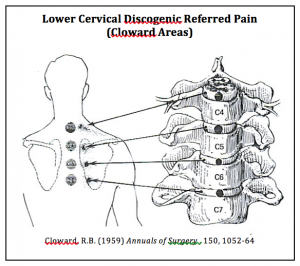
    In the above diagram Cloward in 1959 was able to begin the discussion on referred pain from the intervertebral disc. Here you can see the cervical discs, which are in the neck, can refer pain into the upper back. The only way this is explained is through the idea of referred pain.

    For physical therapists, knowing the true origin of the pain helps us treat referred pain. Moreover, doing a thorough evaluation of a patient requires looking at the patient from a holistic perspective.   Thus a physical therapist evaluates a client from a biomechanical, neurological, and movement dysfunction approach to determine the true underlying problem or dysfunction. Also, having a physical therapist that is well versed in common and even more rare referred pain patterns of the musculoskeletal and even some visceral organs (in case the problem may be more serious) can help determine the source of your pain and ultimately lead to a faster recover.

    Filed Under: Uncategorized

    Do you have a question for a physical therapist?

    If so, you can ask a physical therapy expert at Reid Physical Therapy.

    Ask a Therapist

    Reid Physical Therapy

    11660 Alpharetta Hwy, Ste 560
    Roswell, Georgia 30076

    phone: (678) 667-3435
    Fax: 404-201-2080

    Business Hours: 7am-5pm
    Monday-Friday

    Reid Kelley | Reid Physical Therapy
    Phone: (678) 667-3435 | Fax: 404-201-2080
    A Website by Brighter Vision | Privacy Policy